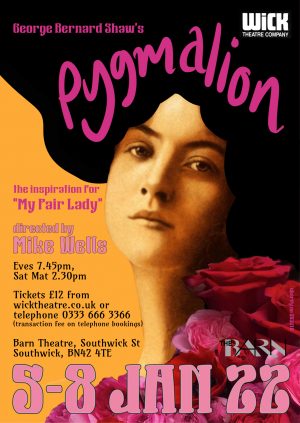
MW wrote: ” Welcome to the New Year and Wick’s first production of 2022. Shaw’s Pygmalion was written 110 years ago but is still relevant today – the experiment undertaken by Phonetics professor Henry Higgins to transform a young woman by changing the way she speaks was an attempt at ‘levelling up’ and revealed the shallowness of class snobbery of the era.
But it is not as a play about social attitudes that has kept Pygmalion so popular with actors and audience for so long. The complex relationship between Higgins and Eliza and the insights about the human heart made this special in 1912 and continue to make it one of SHaw’s best dramas.
My thanks go to all the cast, backstage staff, workshop team, technical support. property and costume advosors and publicity team for their support and encouragement; and a special thanks to Caroline Woodley. We have enjoyed being part of a committed tram and hope yu enjoy the results of their hard worl.
Programme Note #2: Pygmalion
Shaw’s Obsession: George Bernard Shaw [who preferred Bernard] wrote the character of Eliza for Mrs. Patrick Campbell with whom he had a passionate yet unconummated legendary affair. There are many parallels between Pygmalion, the sculptor in Greek myth who fell in love with one of his statues which then came to life, and Shaw and his muse.
Somed of Eliza’s language was considered outrageous in 1914 and made the play a talking point. Mrs Patrick Campbell was considered to have risked her career in speaking the most controversial line: “Walk? Not bloody likely!” The use of the word ‘bloody’ was known as a ‘pygmalion’ for many years afterwards. BUt what has made it so regulalry performed ever since is its intriguing themes of language and class, men and women, and the evolving relationship between the creator and his creation: breaking free and becoming independent.
Publicity #1: Pygmalion
Publication: Worthing Herald
Publication data: January 6 2022 – page 54
Text Header: “Wick Theatre Company offer Pygmalion on stage”
Text: Content
Multi-award winning Wick Theatre Company brings the classic Pygmalion to the Barn Theatre, Southwick in January.
Spokeswoman Susanne Crosby said: “The story of phonetics Professor Henry Higgins’ experiment to pass off a cockney flower girl Eliza Doolittle, as a member of upper-class high society and the impact that it has not only on Eliza but on Higgins himself, has captivated audiences since 1914 when Sir Herbert Beerbohm Tree and Mrs Patrick Campbell who was 49 at the time, created the roles. For many film goers these roles are linked to Rex Harrison and Audrey Hepburn in the brilliant musical adaptation My Fair Lady.”
Pygmalion opens on Wednesday, January 5 and runs each evening until Saturday, January 8, plus a matinee on the Saturday. Tickets in advance from Ticket Source, online via www.wicktheatre.co.uk or by telephone 0333 666 3366. There is a transaction fee on telephone purchases but no booking fee online.
“The play is full of acute observations shown in irony about class and the perceptions of good breeding: Higgins’ plan to transform a young woman by changing the way she speaks as an attempt at levelling up reveals a shallowness of class snobbery which is not just confined to that era.
“But it is not as a play about social attitudes that has kept Pygmalion so popular with audiences for so long. The complex relationship between Higgins and Eliza and the insights about the human heart made this special in 1914 and continue to make it one of Shaw’s best dramas.
“The play takes us from a rainy evening in Covent Garden where the linguistics experts Higgins and Colonel Pickering first encounter Eliza, and it follows their journey through the struggles to make her ‘speak like a lady’.
“We see the emergence of Eliza as a woman who has developed far more than her accent during the process and the emotional effect this has on Higgins.”
Director Mike Wells is thrilled to be bringing Pygmalion back to the Barn stage 40 years since it was last performed by Wick Theatre, and 30 years since he directed My Fair Lady: “It’s amazing that after all this time the themes in this play are still current, that it is still fresh and vibrant and touches audiences now as much as it ever did,” he said.
“Amongst the amazing cast I’ve assembled is Rose Hall-Smith who is fulfilling a lifelong ambition to play the lead role of Eliza. It’s a joy to have such a motivated team, who have also risen to the challenges of safe rehearsals in this unprecedented time.
“George Bernard Shaw wrote the character of Eliza for Mrs Patrick Campbell with whom he had a passionate yet unconsummated legendary affair.
“In fact, there are many parallels between the Greek myth of Pygmalion, the sculptor who fell in love with one of his statues which then came to life; and he and his muse. Mrs Patrick Campbell broke off the affair just prior to Shaw directing her in Pygmalion in the original West End production of 1914 and there were many trials and tribulations in rehearsals. It was the last time he wrote a character inspired by her, even though they remained friends throughout their lives.”
Some of Eliza’s language was considered outrageous in 1914 and made the play a talking point.
NB: The following was only published on-line
Mrs Patrick Cambell was considered to have risked her career in speaking some of the lines, the most famous of which is “Walk? Not bloody likely!”
“The use of the word ‘bloody’ was known as a Pygmalion for many years afterwards. But what has made it so regularly performed ever since is its intriguing themes of language and class, men and women, and the evolving relationship between the creator and his creation: breaking free and becoming independent.
“The characters are among Shaw’s finest creations: the overbearing Higgins; feisty Eliza; her roguish and philosophising father, the dustman; gentlemanly Colonel Pickering; Higgins’ long-suffering mother and housekeeper and the respectable Eynsford-Hills.”
I would like to thank your staff and all the actors for a really excellent production of Pygmalion. What a joy to be able to go to the theatre and experience some real culture!
The whole play swept us along with the story and whilst the limited stage facilities created quite long pauses at times, the opening of the curtains presented a beautiful stage setting. What lovely furniture!
Professor Higgins was truly irritating!!! His enthusiasm and bachelor persona was played to the letter and some of the longer speeches were riveting!
My favourite was Mr Doolittle. He had the capacity to appear in ‘Yes Prime Minister’ with lines that were clearly delivered and went on an on with a conviction that was totally real! And that top hat and tails!!! Fabulous!
Eliza made all the right noises and kept us on the edge of our seats to the end. The final acts when she is trying to explain her situation to Henry Higgins inspired the feminist in me! And love the purple blouse!
Colonel Pickering provided an excellent partnership as he steered the experiment along with a calm and beautifully spoken manner.
I could go on, Henry’s mother was so elegant and beautifully spoken, Henry’s housekeeper was just wonderful. She should always have that part, she was truly scary at times!
And the extras played their parts with a professionalism which supported the main cast in a discreet and well rehearsed direction.
Well done to the team! And thank you again for keeping up entertaining us all in these difficult and very cold times! It made a very, very pleasant change from watching television!