

The Barn Theatre, Southwick Community Centre
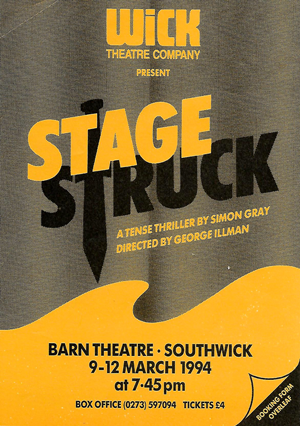
March 9, 10, 11 & 12 1994
Stage Struck
by Simon Gray
Directed by
George Illman
Cast
Jane Porter – Anne
Kevin Isaac – Robert
Andy Chalk – Herman
Barry Heselden – Widdecombe
Production Crew
Continuity – Joan Braddock
Stage Manager – Dave Collis
Set Design – Dave Comber
Lighting & Sound – Trevor Langley
Lighting & Sound – Frances Thorne
Set Painter – Frances Thorne
Set Painter – Sheila Neesham
Set Construction – Brian Box
Set Construction – Michael Davy
Set Construction – Ralph Dawes
Set Construction – Mark Flower
Set Construction – Dave Comber
Set Construction – Dave Collis
Box Office – Margaret Murrell
Properties – Margaret Davy
Properties – Sue Whittaker
Technical Adviser – Bob Ryder
Wardrobe – Judith Berrill
Front of House Manager – George Illman
Publicity – Judith Atkinson
Photography – George Laye
Programme Note #1: Stage Struck
GI wrote: ” Simon Gray is one of the best playwrights writing in England today. His first major play, which appeared in 1967, was the Orton-style comedy, Wise Child, which featured Alec Guinness as a villain on the run from the police – horribly disguised in drag!
Gray’s first big success came in his mid-thirties – in 1971 – with Butley, a tragi-comic day in the life of a college lecturer, whose marriage and homosexual love affair have both fallen apart. This was the first in a long line of successful collaborations with Alan Bates in a leading role and Harold Pinter as director. Like Pinter, incidentally, Simon Gray’s biggest enthusiasm outside the theatre is cricket – so. perhaps not surprisingly, Englishness is at the heart of all his work.
Gray had a string of successes in the 1970’s, with – among others – Spoiled, Otherwise Engaged, Close of Play, The Rear Column and his most poignant and probably best-known play, Quartermaine’s Terms. Tonight’s production, Stage Struck, dates from the end of the 1970’s – one of many which featured Alan Bates in a leading role. \in the usual Simon Gray style, the dialogue is witty and beautifully crafted, and the characterisation and plot cruelly sharp. The big difference about this play is that is also an enjoyable thriller. At its centre are a couple whose life has been in the theatre; and every character in it is at different times, in some way, putting on an act. We’ll say no more!
Gray’s output for the stage slowed slightly in the 1980’s, but The Common Pursuit, Hidden Laughter, and Melon were big successes, the last of these being completely revised recently to produce a marvellous tour-de-force, The Holy Terror. Meanwhile, he has continued to write for film, television and radio – original work, translations and adaptations; he has written novels and some very funny books about life in the theatre; and he has worked as a director for some of his more recent work.
Simon Gray’s plays continue to attract the involvement of the foremost names in the business, who recognise the scope which it gives both for the talent of the performers and the entertainment of the public. Gray is not yet 60, but the body of plays he has already given us is likely to become a long-lasting feature in the repertory of quality English-speaking theatre.
Directors Note. My grateful thanks to the cast and all the other hardworking members of the Company who have assisted me in making this, my first production, possible. Thank you.”
Publicity #1: Stage Struck
Publication: Shoreham Herald
Publication Data: March 4 1994 issue – page 32
Text Header: “Tale of the unexpected at Barn”
Text: Content
ANYONE of a nervous disposition should stay away from Southwick’s Barn Theatre next week.
Award-winning Wick Theatre Company will be staging Simon Gray’s thriller Stage Struck from March 9 to 12.
There are some shocks and surprises in store and also some unexpected explosions. The play poses the question of what do a failed actor-husband, an ambitious actress-wife, a young Australian student and a psycho-analyst have in common. They are all players in a game – a game that, with its twists and turns, becomes stark reality.
George Illman directs the play and has chosen a young, but experienced cast. All four are longstanding favourites with Wick audiences and have appeared in numerous productions. Jane Porter appears as Anne Simon, the wife of Robert, played by Kevin Isaac. The part of Australian student Herman is taken by Andy Chalk and Barry Heselden portrays Widdecombe the psycho-analyst.
Tickets for the 7.45pm performances are £4, available from the box-office on 0273 597094
Review #1: Stage Struck
Publication: Shoreham Herald
Publication Data: March 18 1994 issue – page 15
Reviewer: Alan Olieff
Text Header: “Not as tense as expected”
Text: Content
THE WICK Theatre Company’s production of Stage Struck was billed as a ‘tense thriller’ – but I found last Thursday’s performance not quite as chilling as I had expected. Granted, there were some surprising moments during the performance of the Simon Gray play. Among them was the fright many people received when a gun was fired, especially for the first time. Quite a few of us also jumped when the ‘body’ of a woman tumbled from a loft and remained suspended in mid-air – a fie visual effect which justified pre-show warnings that the play was not for those of nervous disposition. Despite consistent performances from the four-strong cast, I felt that last Thursday’s how sometimes lacked the air of menace and tension required.
Kevin Isaac portrayed Robert as a second-rate actor with an annoying obsession for detail on the domestic front. Watching him present his glamorous wife, Anne, with separate piles of mail – one from fans, the other bills – gave a clue as to why she may have become tired of him.
Jane Porter displayed confidence as Anne, coming across as the prima donna type bolstered by her own success. Her lover, Herman [Andy Chalk] was suitably easy-going although his Australian accent seemed to have travelled via other parts of the world.
Barry Heselden put in a good performance as Widdecombe. He was at first calm and well-spoken in his assumed rôle as analyst. Later, his true identity as a private detective revealed, he showed a more down-to-earth side when under threat.
Robert, as befitting his character, was guilty of over-acting in an attempt to make Widdecombe think he was gay. He later took more of a tough guy approach, helped by the bargaining power of a gun.
Stage Struck dates for the late 1970s. Since then, many other writers have used the ‘twist-in-the-tale’ technique in their plots. As a result it came as no surprise whatsoever when the supposedly dead Robert rose bloodied from behind the sofa to prepare for his final curtain.
