


Production : Pack of Lies
Reference : 2922603
Auditions: Pages 0
Publicity : Articles 1 – 3
Rehearsal : Pages 4
Set Design : Pages 1
Programme : Pages 1 – 8
Reviews : Articles 1 – 2





Review #1
NODA:
Group: Wick Theatre Company
Show: Pack of Lies
Writer: Hugh Whitemore
Venue: The Barn Theatre Southwick
Date: 26th March 2026
Director: Suse Crosby
Content:
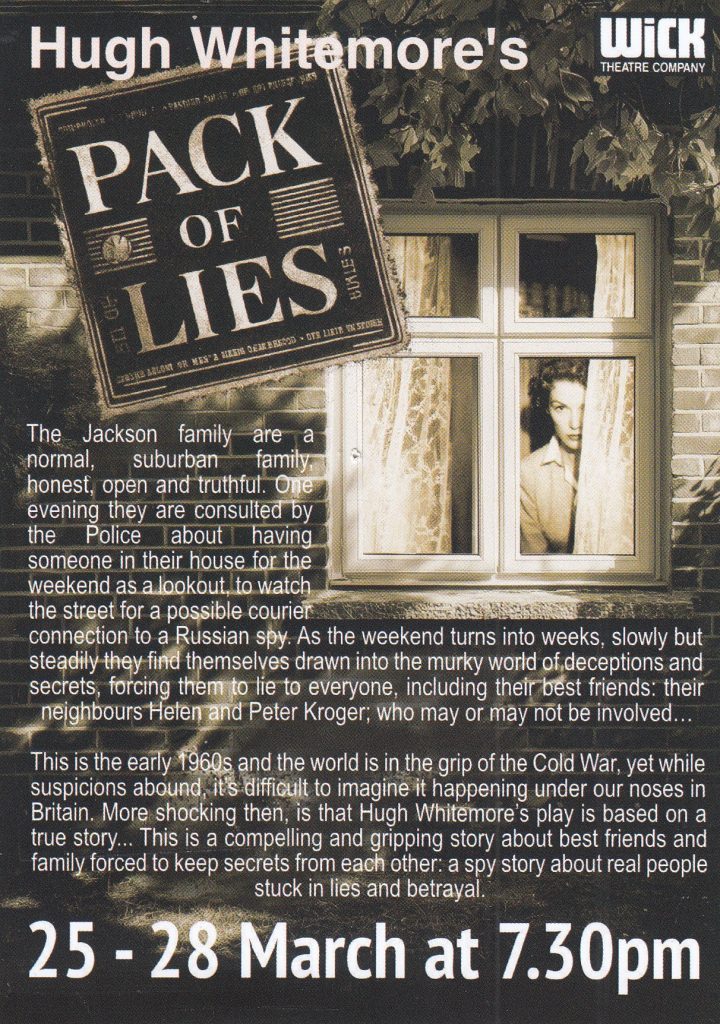
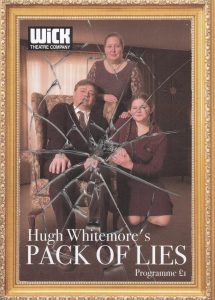
The striking publicity and informative programme for Suse Crosby’s production of Hugh Whitemore’s Pack of Lies’, tantalisingly suggested an evening of intrigue and shattered beliefs. This was delivered to sometimes audible gasps from the audience as the story of the famous Kroger spies, was told with compassion and authenticity.
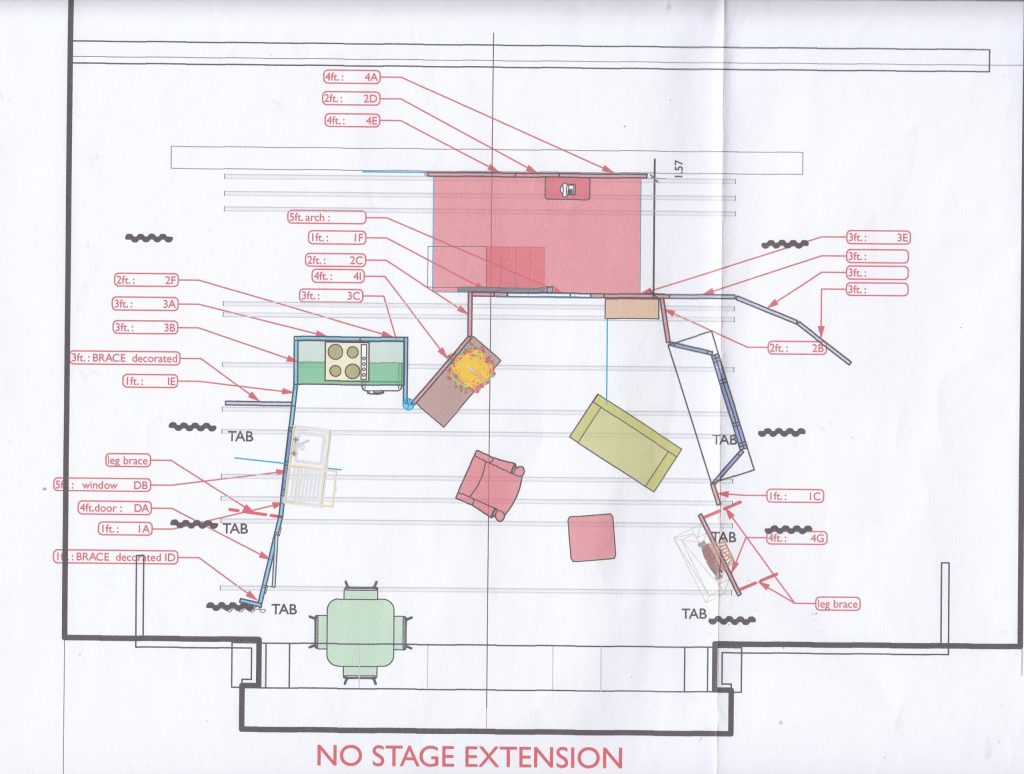
The audience were immediately transported back to the early 1960s owing to a realistic and well-designed set. The layout indicating a kitchen, living area, hall and upstairs not only established a believable 1960s home but supported the excellent pace of the play by avoiding lengthy scene changes. Attention to detail for both set design and props was meticulous such as the rubber rings to secure the tea towels, the period appropriate packet of Cornflakes and the fake electric fire.
The authenticity of the era was further enhanced by Maggi Pierce’s well established skills in wardrobe management. All the outfits looked entirely accurate for the period including the old fashioned pinny, square heeled shoes and American Tan tights.
Caroline Marchant played Helen Kroger with seemingly endless energy. She bought a brilliance to her character which was particularly evident when she was dancing during her first scene and when she was cajoling the conflicted Barbara and Bob to celebrate Christmas more heartily. Through her gestures and speech, she fitted the ‘Dizzy Lizzy’ nickname perfectly but nonetheless conveyed that her affection for Julie and Barbara was genuine.
Matt Arnold as Helen’s husband Peter was a solid and dignified antidote to Helen’s exuberance. Appearing to be a restraining influence on Helen’s passionate excesses, he nonetheless displayed his own passions when he movingly spoke of his conversion to communism. Both Peter and Helen maintained their Canadian accents consistently across a range of emotions for the duration of the play.
Abbi Crawford looked supremely confident as the ‘civil servant’ Mr Stewart. Moving with ease and with excellent posture he gave the impression of a relaxed and friendly official who was seeking consent for his covert operations. Beneath his superficial charm it was evident (from some rather nice eye movement) that he was continually checking out his surroundings and manipulating Bob and Barbara into compliance.
Taking on her first ever role on stage Hadera Burki gave a very natural portrayal of Thelma. For someone so new to performing she impressed with her open body gestures, confident movement and variation in tone and expression. She successfully conveyed Thelma’s professionalism despite her growing affection for Barbara which made Thelma a rounded and likeable character. Hadera should be proud of her first stage performance, and it would be good to see her develop her skills further in future productions.
Although a small role, Sally confidently played by Rosy Armitage established a nice contrast to Thelma’s evident affection for the Jackson family. She created a light and happy character who breezed across the stage as easily as she breezed through her job. Her lack of empathy for Barbara therefore struck as amusing rather than unpleasant and added to the more humorous moments of the show.
It was good to see Julian Batstone returning to acting and he gave a lovely portrayal of the traditional, conformist and initially naive Bob. Despite appearing, eager to please, reluctant to challenge authority and unable to deal with too much emotion, Julian’s accomplished understated acting created a likeable character who was as warm and comfortable as his old brown cardigan! His facial expression during the Christmas scene beautifully portrayed his discomfort with his changed world and his closing speech provided one the most moving moments of the play.
A welcome newcomer to the Barn stage, or indeed to any stage away from her school, was Sophie Hosier who gave a delightful performance as the teenage Julie. She portrayed the frustrations of a teenager with energy and accuracy, which provided humour without slipping into caricature. Her timing and audibility were excellent as was her natural looking reactions and periodic stillness. Sophie is clearly a talented young actor and it is exciting to consider what roles she might take on next.
Anna Quick gave an outstanding performance as Barbara. With her subtle expressions, perfect diction and talent for authentically portraying a wide range of emotions, she was utterly convincing as an ordinary 50s housewife whose world and beliefs were being turned upside down. Her ability to convey Barbara’s inner turmoil, emerging frustrations and challenged loyalties was extraordinary. Her bewilderment at her friends emerging betrayal, anger at her and Bobs perceived powerlessness and ultimate grief at the loss of one of her very few friends was heartbreaking. In her final monologue, she looked and sounded utterly exhausted and broken which made her early death seem sadly inevitable.
Barbara, Bob and Julie worked well together, all giving generous performances which allowed each of them to shine. Their uncanny resemblance to each other and ease of their interactions created a totally believable 1960 s family unit.
The monologues were beautifully lit by John Garland which showcased the inner life of the actors whilst facilitating quick and smooth transitions between scenes. Clever use of beautiful music augmented the atmosphere on stage and created a more lasting impact on the audience’s perception of mood than silence ever could.
The audience were clearly captivated by this story of intrigue and broken beliefs. Suse Crosby’s dedication to detail across all aspects of the production are testament to her skill as a director and to her passion for this play, her cast and her crew.
Claire Wiggins
Assistant Regional Representative NODA South East
From The Gods:
Group: Wick Theatre Company
Show: Pack of Lies
Writer: Hugh Whitemore
Venue: The Barn Theatre Southwick
Date: 27th March 2026
Director: Suse Crosby
Review by Simon Jenner
★ ★ ★ ★
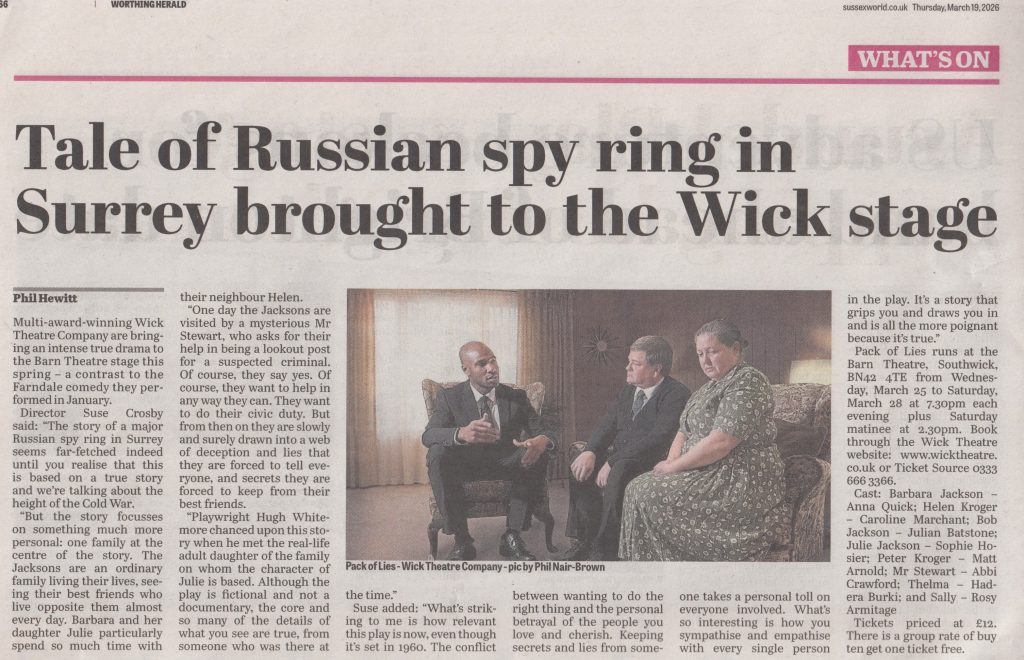
Ruislip October 1960. Not the suburbia you expect to be door stopped by the government and made an offer you can’t refuse: to have genteel spooks take up residence like furies upstairs in your daughter’s bedroom. And spy on your best friends. Even stranger if the story’s true. Hugh Whitemore 1983 Pack of Lies plays at The Barn, Southwick directed by Susanne Crosby till March 28.
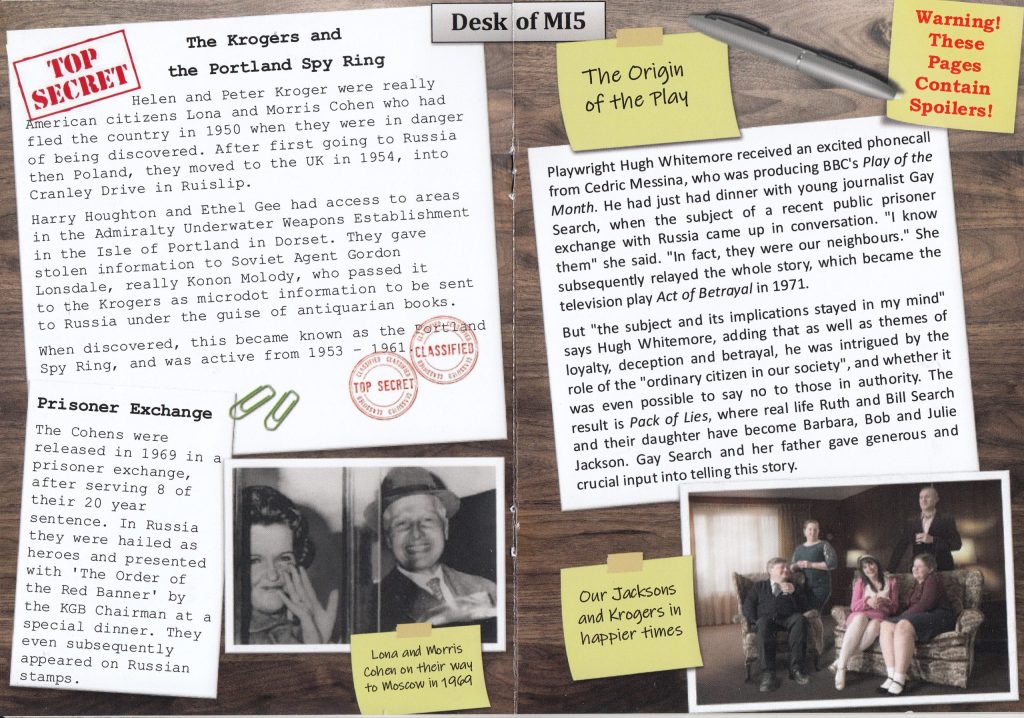
Based on the memories of journalist Gay Search, the original Julie of the play – which became Cedric Messina’s BBC TV play Act of Betrayal in 1971 – Whitemore felt there was more. Search and her father gave generous and crucial input into his play. In a friendship, who betrays who? Is an act of betrayal one-sided? Where does deception end and betrayal start? And what part of friendship is genuine, what part mere use? There’s a rich interaction over the two-hours-twenty with interval, that goes beyond the nominal thriller which really ratchets up in Act Two.
Sophie Hosier (Julie Jackson) and Caroline Marchant (Helen Kroger). Photo Credit Sam Taylor
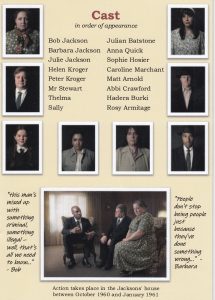
Bob Jackson (Julian Batstone, impressively phlegmatic) and perhaps the central character Barbara Jackson (Anne Quick) live with their mid-teen daughter Julie (Sophie Hosier, a winning mix of forthrightness, pique and occasional vulnerability). They’re often visited though never at weekends, by their breezy Canadian neighbours extrovert Helen (Caroline Marchant) and quietly genial antiquarian bookseller Peter Kroger (Matt Arnold). Barbara’s both a fine artist and superb dress-maker and she’s creating a white dress for Helen for Christmas, fast approaching.
Marchant turns the volume up on Helen: she’s larger-than-life in jazzy period clothing, positive and well free-spirited, always acutely aware of the handsome young bodies of Julie’s ne-er do well boyfriends when she spots them in swimming pools. Marchant captures Helen’s emphatic warmth too, and turns it to acetylene when relating in a monologue downstage what happened to her in 1950.
Helen shares confidences with Julie, can persuade her to sensible actions when Barbara despairs and lays down fiats: especially riding pillion in a motorbike in the days before helmets too. Hosier and Marchant enjoy a scene where the world might seem headed somewhere else. Arnold’s bright Canadian persona is affably believable, a quiet Canadian so to speak, impressive in his monologue downstage (a Whitemore device in this play).
Their peace is disturbed not to say their routine, with a call then a visit from Mr Stewart (Abbi Crawford), a suave “civil servant” attached to Scotland Yard via the call, though clearly something other. Crawford gleams as the reasonable face of an order, always downplaying power. He explains there’s someone who visits the Krogers and they might or might not know he’s conducting some illegal business. is resistant to Stewart’s proposals, and indeed the tenor of his conclusions. They’ve known the Krogers over five years. Bob quietly absorbs what he’s told. He works on airfields, he knows the drill. “This man’s mixed up with something criminal – well, that’s all we need to know.” Barbara though in Quick’s slowly incandescent performance, fights all the way. And how will they keep this from Julie?
Abbi Crawfoed (Mr Stewart). Photo Credit Sam Taylor
Two spooks take up residence, attracting as little notice as possible.First Thelma (Hadera Burki, playing stum in a bright blankness, with a chink of sympathy); and later conversing with her colleague Sally (Rosy Armitage). In Armitage’s hands Sally’s altogether more sardonic, probably Oxbridge, contemptuous of Barbara’s suburban drudgery. There’s a quartet of women commenting on the day Clark Gable died.
Quick inhabits Barbara’s quandaries: that of decency and friendship, betrayal of that, and as she later says: “People don’t stop being people just because they’ve done something wrong.” As Quick’s character becomes more enraged through Act Two, the more Quick impresses: it’s a superb performance, the standout of the evening. Elsewhere though each character impresses interacting. The listening quality of the whole cast, genuinely responding and not delivering, is a hallmark of a fine production. There are slight quibbles with clarity and sound-spots. Quick in particular surmounts them effortlessly though.
The fine set of a suburban semi of the late 1920s is divided in a 1950s-style green and cream kitchen slightly underused, and the lounge: featuring a bay window and stained glass of the period stage left. There might have been a little more theatrical preoccupation, though there’s just enough and the set and props team (there’s no named lead designer) are noted below. They deserve praise. Lit by Martin Oakley and Crosby, with he and Julian Batstone crafting the sound design.
Batstone’s final soliloquy downstage is a moving testament to fractured friendship that didn’t quite end on January 7 1961, but set ripples. Who forgives who and who doesn’t is revealing and perhaps surprising: people are unexpectedly hurt, whatever their profession.
This one-time hit though now rarely-staged Olivier-winning play (for Judi Dench) is worth tracking down and you’ve a little more time to find it in Southwick.
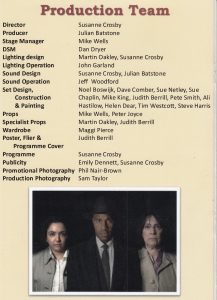
Producer Julian Batstone,
Stage Manager Mike Wells,
DSM Dan Dryer,
Lighting Operation John Garland,
Sound Operation Jeff Woodford
Set Design, Construction & Painting Noel Boswijk, Dave Comber, Sue Netley, Sue Chaplin, Mike King, Judith Berrill, Pete Smith, Ali Hastilow, Helen Dear, Tim Westcott, Steve Harris, Mike Wells, Peter Joyce.
Specialist Props Martin Oakley, Judith Berrill.
Wardrobe Maggi Pierce,
Poster Flier & Programme Cover Judith Berrill, Programme Susanne Crosby,
Publicity Emily Dennett, Susanne Crosby,
Promotional Photography Phil Nair-Brown,
Production Photography Sam Taylor.
Matt Arnold (Peter Kroger) and Caroline Marchant (Helen Kroger). Photo Credit Sam Taylor